West London Drum Tutor — Journal
Notes From the Kit
Practice, technique, gear and history from nearly 30 years behind the kit
Finding the Voice of a Drum: Notes on Tuning
Every drummer eventually has to make peace with a stubborn floor tom. Here's what years of tuning kits — good ones and battered ones — has taught me.
Six Seconds That Changed Music: The Amen Break
A B-side drum solo from 1969 became the most sampled beat in music history — and it's still shaping the way drummers think about groove today.
Why I Keep Recommending Mapex
Having played and toured on Mapex kits, here's an honest look at where they sit in the value-for-money conversation — for beginners and professionals alike.
Learning to Speak Fluently With a Double Bass Pedal
Picking up a double pedal is easy. Using it with taste and control is a different discipline entirely — here's how I approached it, and how I teach it.
Finding the Voice of a Drum: Notes on Tuning
A well-tuned drum kit is a beautiful thing — and a badly tuned one is one of the fastest ways to make a good player sound average. I've spent years tuning kits, and the honest truth is that most of them I've worked on weren't mine. They were old, borrowed, battered, or belonged to a venue that hadn't touched the heads in years. Learning to make a stranger's kit sing, quickly, under pressure, is its own skill — separate from playing entirely.
The stubborn one: the floor tom
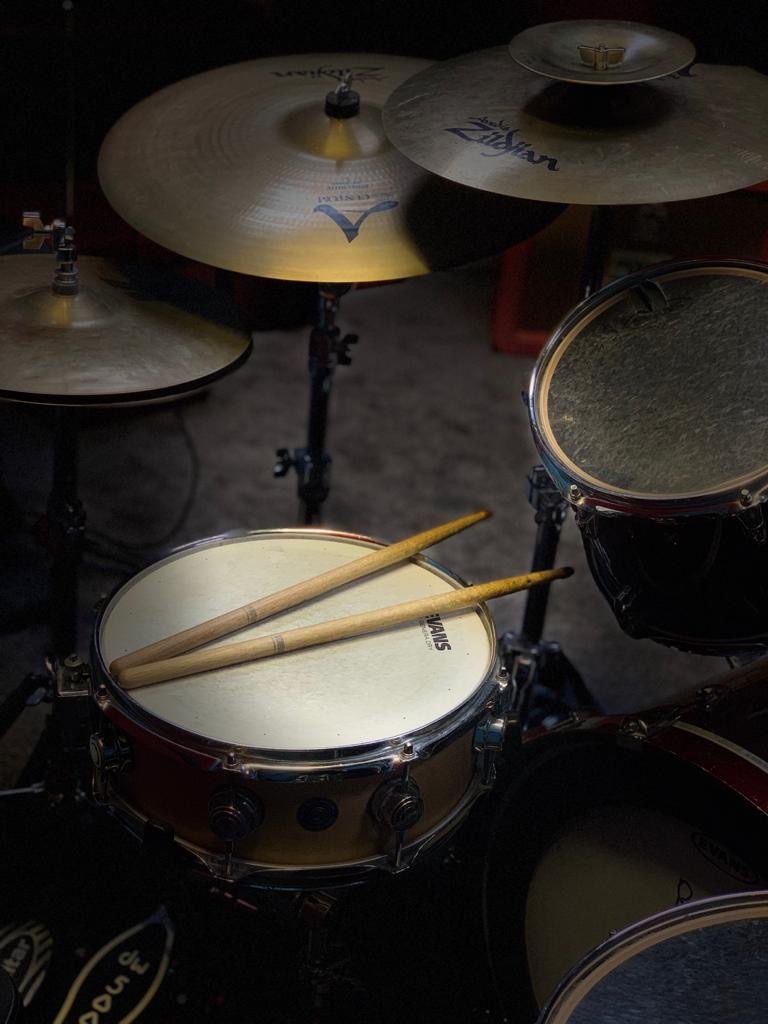
If you ask any drummer which drum gives them the most trouble, most will say the floor tom. It's mean and stubborn by nature — a bigger shell, longer sustain, and far more sensitive to uneven tension than people expect. Get it wrong and it either chokes or rings forever. Get it right, and it finally finds its own voice — a low, resonant thud that sits underneath everything else on the kit. That moment, when a floor tom finally "sings," is genuinely one of the small joys of this job.
The generous ones: bass drum and snare
By contrast, the bass drum is usually the most rewarding and responsive drum to tune — it tends to reward careful, even tensioning quickly and audibly. The snare is similarly forgiving; small adjustments make an immediately obvious difference, which makes it a good drum to practise tuning on if you're learning the process yourself.
Why this matters for students
I teach tuning as part of lessons, not as an afterthought. A student who understands why their kit sounds the way it does — and how to fix it — becomes a more complete musician, not just someone who hits things in time. It's the same principle I apply across teaching generally: technical understanding and musical instinct aren't separate tracks, they inform each other.
Six Seconds That Changed Music: The Amen Break
Every drummer should know this story, because it's proof that a single, honest drum performance can outlive the record it was recorded for by decades — and reshape entire genres nobody had invented yet.
In 1969, a soul group called The Winstons recorded a single in Atlanta called "Color Him Father." It won them a Grammy. Nobody was paying attention to the B-side, an instrumental called "Amen, Brother" — a cover of an old gospel tune. About a minute and a half in, the band drops out entirely and the drummer, Gregory Coleman, plays a short, loose, unaccompanied break on his own. It lasts roughly six or seven seconds.
From forgotten B-side to the most sampled break in history
That break sat quietly for almost two decades until hip-hop producers in the 1980s started digging through old soul and funk records looking for raw material for samplers. Coleman's break — swung, slightly loose, with a distinctive delayed snare hit — turned out to be exactly what they were after. It appears in early hip-hop records through the late '80s, and then, in the 1990s, it became the literal backbone of jungle and drum & bass: chopped, pitched up, rearranged, and looped into an entirely new sound. It's now widely considered the most sampled piece of recorded music in history.
Why drummers still study it
What makes the Amen Break worth a drummer's attention isn't just the history — it's the feel. Coleman wasn't playing anything technically complicated. It's the small imperfections, the ghost notes, the slight delay on that third-bar snare hit, that give it character no quantised, machine-perfect version has ever quite replicated. It's a genuinely useful reminder for students: groove and feel often matter more than raw technical difficulty.
Why I Keep Recommending Mapex
Affiliate disclosure: this post contains affiliate links. West London Drum Tutor may earn a small commission on qualifying purchases at no extra cost to you.
I get asked fairly often what kit a student should buy once they've outgrown a starter kit but aren't ready to spend professional money. My honest answer, most of the time, is Mapex — and it's a recommendation I've made consistently for years, on stage and in the studio, not just in lessons.
Where Mapex sits in the market
Mapex kits are built with a level of touch and responsiveness that's genuinely hard to find at their price point. Compare cost to performance across the mid-level market and Mapex wins more often than not — you're getting shell construction and hardware quality that competitors typically reserve for a tier above. They come in a wide range of sizes and finishes, including birch, maple and walnut shells, natural or sparkle finishes, which matters if a student is starting to develop their own taste in sound and appearance.
Personal experience
I've used the Mapex Saturn series both in the studio and on tour, which is a genuinely useful test — a kit that holds its tuning and its sound quality across a tour and multiple recording sessions tells you a lot more than a five-minute play-test in a shop. It held up.
Who it's for
I recommend Mapex to intermediate students moving beyond a beginner kit, and equally to gigging musicians who want professional-feeling response without professional-tier pricing. I'll happily be challenged on this — but I haven't yet found better value at that level.
Browse Mapex kits →
Learning to Speak Fluently With a Double Bass Pedal
Picking up a double bass pedal is easy. Almost anyone can strap one on and start hammering out fast, even patterns within a week. Playing one with actual musicality — dynamics, control, and taste — is a completely different discipline, and it's one that takes most students far longer than they expect.
Where most players get stuck
The trap with a double pedal is treating it purely as a speed tool. Once a student can play fast, they tend to stop developing anything else — no dynamic control, no sense of when restraint is more musical than density. Genuine fluency with a double pedal means it can disappear into the groove entirely, rather than announcing itself.
How I approach it in practice
The same structure I use for every technical skill applies here: build it slowly, deliberately, with a metronome, before trying to make it musical.
- Start with rudiments on the feet. Singles, doubles, and paradiddle patterns played between the two pedals, exactly as you'd first learn them on a snare drum.
- Work subdivisions gradually. Triplets, straight semiquavers (16th notes), and demisemiquavers (32nds) — each practised slowly enough to stay clean before pushing tempo.
- Layer in the hi-hat. Once the feet are independent and even, add an eighth-note hi-hat feel on top and listen for whether the double pedal work is still locked in, or falling apart under a second layer of coordination.
- Only then, apply it musically. Take the same patterns into real songs and fills, and consciously practise using them sparingly — restraint is a skill in itself.
A minimum daily commitment
I generally recommend at least an hour of focused practice a day if you're serious about building this kind of technical control — split between metronome rudiment work, reading (grade books or other material), and playing actual songs. All three matter; drilling technique alone without applying it musically tends to produce technically capable players who don't groove.